
If you’ve been on the spiritual journey in any capacity, you’re probably familiar with the Buddha’s teachings on attachment and aversion as the root of all suffering, and the idea that pain is inevitable yet suffering is optional. They are simple ideas and readily available for us to experience, yet often still so challenging to release ourselves from their grip.
I wanted to offer insight into some of the deeper possible mechanisms at play, to help give you a few extra anchors to hold onto, as you try to separate yourself from your own suffering. A good starting point for us comes from the work of Dr. David R. Hawkins who created a model that he refers to as the Scale of Consciousness.
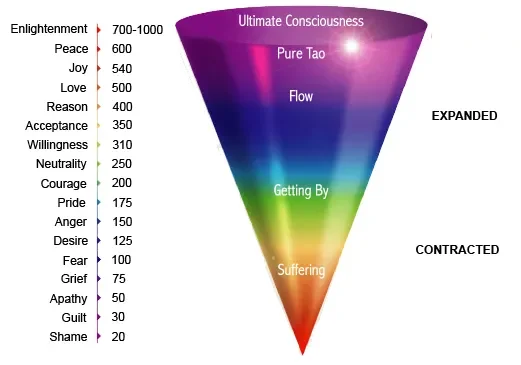
The Scale of Consciousness - Dr. David R. Hawkins
This model essentially presents the range of human emotion as a continuum - different frequencies of energy, ranging from shame and guilt at the bottom, right up to joy and peace, and enlightenment, at the top. Previously I’d always thought of emotions as quite independent of each other - they can have such vastly different textures so it seemed surprising that they could be so seamlessly connected. And yet, considering emotions in this way has opened up so much of my understanding of the healing process and how we often remain stuck. The core insight being:
The lower our emotional state, the more we’re resisting the reality of the present moment.
Now that might seem to be an obvious statement at first glance but it’s really worth some consideration. Of course, there are many situations where it’s perfectly justified for us to wish things to be different. If we’re being physically attacked, anger or fear are appropriate responses in the moment and the energetic reflexes they come with are essential in trying to keep us safe. The problem often comes when we hold onto that wish for reality to be different when there’s little possibility of change, or in situations where we are too attached to an unconscious belief that is actually detrimental to our situation.
If we lose a loved one, the grief we feel is really the pain of love that no longer has anywhere to go. It’s understandable that we wish this stark new reality to be different - of course we wish they could still be here with us. And yet we are still ‘denying’ the current reality in which we find ourselves. Now I’m not suggesting this is a process to be rushed - it naturally takes time to come to terms with loss like this and integrate our new reality without them. My point is that healing is really a process of finding our way back to an acceptance of reality.
Trapped by Limiting Beliefs
Since we’re talking about healing, let me use an example that I see often in therapy sessions and men’s groups that not only illustrates how this scale of emotion works, but also speaks to the sort of psychological bind that is often the root cause keeping us stuck in the first place.
Let’s consider a man who grew up in a household where he was taught “boy’s don’t cry”. This man was shamed, ridiculed and judged any time he showed emotion, to the point that he will now do anything it takes to suppress his feelings. Now imagine he finds himself in a situation where he’s being provoked and can feel his emotions building. For this man, the reality he’s learned is ‘acceptable’ is for him to be strong and stoic, and in control of his emotions.
The closer he comes to tears, the further his emotional state drops as he wishes for reality to be different. Initially he might experience frustration at the provocation, which becomes anger - perhaps he becomes aggressive towards the perpetrator in defence. Next there is a desperate, compulsive craving or desire for the current situation to be different - he will become reactive and try to force his way out of the situation. As he gets even closer, fear arises as he realises he might not be able to hold back the tears. At this point he may lash out like a frightened animal in a last ditch attempt to escape.
If he’s pushed further and the emotions finally come, he moves into grief. Quickly from this point he might move through the apathetic despair of realising he ‘failed’, then guilt and finally the shame of not being ‘man enough’.
As you can see, the lower his emotional state drops, the more he resists and wishes reality to be different. But the bind here is that ‘boys don’t cry’ is just a concept. There’s no tangible substance to it - it’s simply an idea that’s been passed down for generations that maybe at one time had some benefit in society - maybe not. And yet if we believe these ideas to be absolutely true, we are not only bound by them but will do anything in our power to maintain them.
From the boy’s perspective - looking from within his belief structure of ‘boys don’t cry’, the obvious solutions to his building emotion are to try harder to suppress them, toughen himself up, and punish others who show weakness.
The belief justifies the actions.
Belief Structures and Justified Action
I would argue that all harm perpetrated in the world is carried out in this way - by people who have collected such a distorted and convoluted world view that they feel justified in doing whatever it takes to try and force reality to conform to the way they’ve learned it should be. That’s a dark thought experiment to go down - to try and understand what it would take for us to feel justified to carry out some of the atrocities we’re currently witnessing in the world. And yet, in my opinion, it’s a necessary process for us to try to confront if we’re going to be able to create any meaningful change in society.
The actions we witness are in many ways the coping responses trying to protect the underlying belief structures. And when we judge, and fight, the actions without understanding the root cause of the beliefs that drive them, we often reinforce the beliefs themselves.
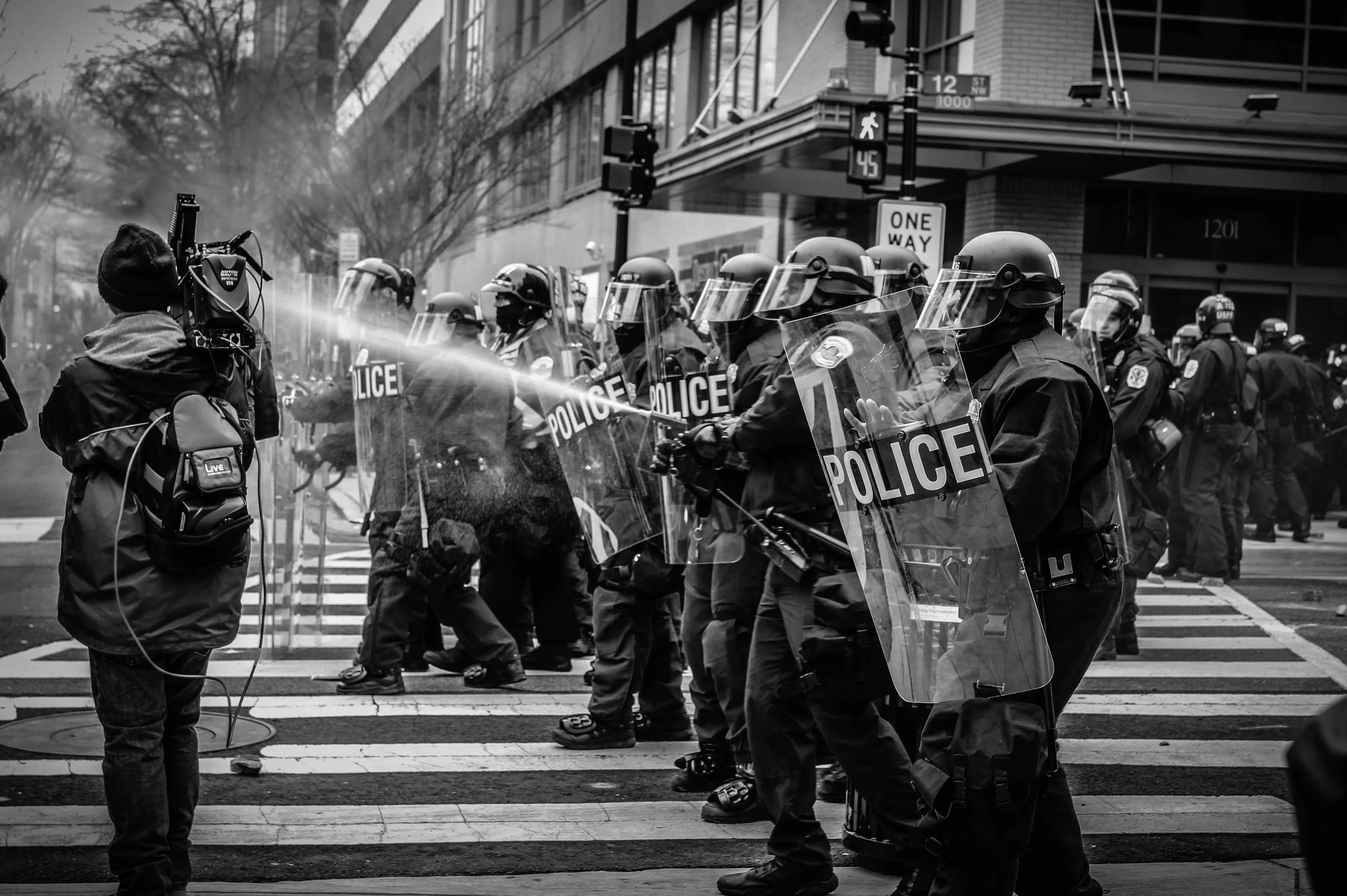
Let me give you an example. If I work for the security services and, every single day, I witness the absolute worst of humanity - terrorist attacks, murders, kidnappings, there will surely be a shift in the way I perceive the world. I imagine I would start to see more and more situations as a threat. Fear and paranoia would build and I would likely start to take action to control my environment. So I might suggest tighter controls in order to monitor the public in the name of safety. But when the public feel the shift of their freedom being taken away, they might protest and riot, and fight with the police. Within the belief frame of the world being a dangerous place, this only further justifies the need for control. It makes me clamp down harder.
And that makes our reality smaller.
Healing and Expansion
For things to improve, it’s the opposite that needs to happen - we need to move beyond the limiting belief and find a more expansive perspective. In the case of the boy, to actually heal and grow, he needs to find acceptance of a reality in which he’s able to show emotion, because then he can be free of the psychological bind and move more freely in the world. There’s no shame in showing emotion unless you believe there is. It’s perfectly possible to cry while also being a strong and powerful man.
Of course, there are a lot of threats in the world right now. And as I say, I believe these to be perpetrated by people who are deeply attached to distorted beliefs and ideals. I’m in no way saying we can’t stand up and fight for the world we wish to live in. But the nuance that’s needed is that, the more we can understand the reasons that validate the underlying beliefs - the more we understand the person, the better chance we have to meet them and respond to their reasoning instead of reacting to the actions and coping responses they create. They know not what they do.
To do so, we need to take action ourselves - to expand our capacity to integrate more challenging moments, so we can move beyond fear. It’s hard for me to meet the darkness in another if I haven’t been there, or accepted the potential for it in myself. The more I can confront my fears and push my limits, if I can come out the other side without stretching too far, the more capacity I will be able to hold to meet the entirety of life. I’m stretched to expand myself while continuing to try and find a way back to grace and acceptance for the darkness the world brings me.
If you fully accept what you are afraid of, can you still be afraid?
Now we obviously have limitations in this respect - many of us will never be able to grow enough to meet the darkest parts of humanity currently coming to the surface. But we can take action to improve things in our immediate vicinity. It’s a collective shift that’s needed - we can all come together to stand up for the greater good and protect our communities. And having a tight-knit, capable and organised community around you, that has got your back, is one of the best antidotes to fear and the threats of the modern world.
Suffering arises from resisting reality. Healing arises from accepting it, which loosens the rigid belief structures that keep us trapped and allows us to expand into freer engagement with life. We suffer because we hold onto the meaning of what was wrong with the experience, which stops us from accepting the reality that it has now happened and is already a part of our life. This is no easy task - especially in the face of such horrors as we are witnessing in the world today. And yet it’s what we must do.
Reflections:
Where in my life am I resisting reality?
Which beliefs am I holding as absolute that might be harming me?
How might I allow a feeling I usually avoid to exist without judgment?
-
Thanks for reading.
James Garside is a psychotherapist and men’s group facilitator based in Kettering, Northants. To enquire about psychotherapy services in-person or online over Zoom, get in touch.